menu

Showing posts with label Kenya. Show all posts.

January 23-24. Mombasa.

A very fortunate series of hitches takes us to Nairobi and from there to Mombasa, where we arrive very early in the morning, sit on a bench and gaze at the merely male, mostly Indian swimmers. We have a good time in Mombasa, eating out in a phenomenal restaurant and sleeping in a very affordable hotel that features phenomenons of a different kind. I have a déja vu in Mombasa of Panama city. It's a similar blend of a colonial old town and a busy port city. This one serves most of East Africa.

We watch the televised event for Haiti in our hotel, featuring all those celebrities, and we learn from it. Wycleff Jean does a great performance (something along the lines of "Earth Quake / that makes the earth shake / but the spirit of the Haiti people never gives in"), and even Madonna is there.

Giraffes and baboons flank the Chinese-built highway that takes us back to Nairobi, safely on the back seat of a young couple's car: hitchhiking never was that easy. We invite them for dinner in Nairobi and arrive home late.

January 17-22. Finishing the Rainbow.

Those are the days in which we finish the painting of the orphanage and travel back to Nairobi to talk to corporates interested in sponsoring our initiative.

We feel very welcome and are glad to see Philip again. The walls have been plastered but they need some time to dry, so the painting can't start straight away. We decide to visit Obama's grandmother first. A matatu ride takes us to the junction, from where three motorcycles bring us to Kogelo, to the estate of Obama's grandmother. There is a gate and a guard who requests us to write down our names in the guestbook, but it's not a high security area. We are told that granny complains because they don't let her go to the market alone, afraid she might be kidnapped by dark forces. They also tell us she has malaria once again so she is not very strong. We have to wait a little because she is taking lunch.

January 13-15. To the village.

An Irish priest is not necessarily a Samaritan.
We wake up in Talek and get a ride to Narok. But it is too late to hitch further to Kisumu and we are stuck for the night. A friendly guy, county clerk by profession, brings us to the house of an Irish priest. He is not there and upon hearing that there are strangers in his house he is outraged. "Throw them back on the streets!" we hear him shout through the phone. Long live Jesus Christ, Mr. Prissy Priest.

We make it to the village and spend the night at yet another cheap guesthouse. In the local bar a guy puts his leg in his neck and annoys HD. We know it is time to leave and we finish our beers in front of our room.

The next day we hitchhike to Kisumu and we have a great time. There are so many friendly Kenyans and the experience in the Maasai Mara is quickly forgotten. Philip welcomes us back home and we feel good being back in the village. The walls have been plastered and prepared for painting.

I remember taking the bike to the Kisian market to get some eggs and vegetables. Dirtroad with potholes, no light, no brakes. I am proud I only fall twice. We have omelettes.

January 12. Birthday.

It's my birthday today. We get up at five am but of course Mr. Maasai Chief is not there. We ring him and he is still far away. We decide to go with another car and it seems we are going to have a friendly relation with the driver. But he has smelled money. He has betrayed us by promising to take us to the Maasai Mara, including a ride inside there (since that was why he had taken the 4wd). In the end it turned out that it was just the taxi to the entry of the Maasai Mara. The guy's name is Edwin and I tell you, beware of him. Beware of all the guys in that area. They smell your money and they are relentless like the vultures in the park.

Januari 1-11. Kayole. Joy Valley. Safari walk. Cheetah. Narok.

1
We get up early enough to make it to Kisumu town on time.
We have an interview with Mr. Masese for The Standard.
Then we take the bus back to Nairobi.
We arrive in the darkness, we meet some other couchsurfers who are enthousiastic about CT.
We have a chicken meal at Alanya's place, where we are "invited" for a delicious chicken. We sleep late.

2
Next day is lazy. Catch up with writing. At 20.20 we get Kenya from the airport. The flight is delayed.
We take her to Kayole and spend the next day around the house, while Kenya is getting some rest.

3
We go to town to do some sight-seeing. Being late already, we plan a comprised walk to the Maasai market and the 1998 US embassy bombing memorial park. The park is peaceful, with King and Ghandi quotes and the names of the 200 deceased. There is a sculpture made out of debris and an information center. Violence has never lead to anything good. F.Y.I.

Yet, before reaching the grass covering the former embassy site, I had felt inclined to be violent towards a very annoying vendor of "traditional" African stuff. He followed us and kept asking why we weren't interested in buying or browsing. Because we cherish our individual culture and just want to be left alone. I actually told him we didn't like him and that scared him off. On our way back we passed by the Maasai market and, of course, we were surprised by heavy rainfall. Damn!  We should have come here earlier... nothing good comes from violence, see? That is so cheesy, now we are simply associating and applying Ghandis words to whatever we experience, and you know what, in doing so we are goddamn VIOLENT. And besides, the heavy rain was a swell experience. It gave us interesting pictures of running merchants dragging their heavy sacks of merchandise to dryer places under the trees. And I managed to improvise a three-person-raincoat that got us more or less try into a coffee house with wifi. And there I managed to solve my bank problem using a toothpick. I pinched the little machine that generates the code for online banking, hence I was applying some real violence. But I applied it with consideration. The toothpick solved where a lengthy conversation and official letters posted to the bank had failed. The bank didn't reply anyway and I had to get through to them by contacting the young employee that had served me in Amsterdam via - facebook!

So we feel good and have a delicious welcome dinner for Kenya, over which we discuss our activities in the country. The raingods bless us with a mere drizzle as we stroll along the Moi Avenue towards the Matatu-stage, to write a sentence with the rhythm as if it has been emulsified and flavoured by a professional glossy author who has put off cocain to boost his career. The matatu is quiet and we are safe. Even though we have to walk home alone, no criminal intend we smell on our way home. Tomorrow we will do something.

Waiting for Willis to go to Joy Valley orphanage.

Cybercafe. I upload some photos of our Kisumu-orphanage and attempt to grow the online attention for the project. A few million mouseclicks would do the job. It just depends on who fingers the mouse.

4
Joy Valley. Serious talk with Jared. The first time in my life I get a preacher quiet - it is a personal milestone for my rhetorical skills. At one point I even throw a bible quote at him: those who beg will be cursed. And he gets it.
It is vital he learns not to beg in order to be MUCH more attractive for donors with shorter understanding of his desperation than ourselves. So we say goodbye without a donation, leaving him with the daunting task to explain to his hungry orphans why the white skin has not given money. I explain we are doing what we can making his case known and bringing other travelers. I ask him to be patient.
I have already made up my mind. We will teach him a little lesson. So after we leave, we rush to some stalls to buy well over 90 bananas for the children. We go back and knock on the steel door again to surprise them. Jared seems to understand what we want to say. I hope it will last and he will perform in the best possible way to provide for his orphans.

5
Lazy day. Walk around Kayole.
Waiting to go to Nairobi nat park; a guy had his car coming from Kisumu, too late. So we stay around the house instead and postpone our trip.

6
If you are not daring enough to face the wildlife inside one of Kenya's great National Reserves, there is the Nairobi Safari Walk, a comfortable wooden overpass. They have a tame cheetah and we could pet it - for a dollar and a sour face because they are used to more than a dollar.

We have a good and very affordable dinner at Greenview, a local restaurant in downtown that I recommend you.

We go out to a club and dance. I don't really feel like it. It is a bad experience. I end up paying to bail my friend out for eight dollar. Having  money is a curse if you have a heart. Then it does the opposite of giving you power. I yell "here is the white skin / that pays everything".
I hear later that they are furious about the racist allegation, their minds too blunt to understand the subtle irony.

7
We travel to downtown, Yeon writes in Java. I start visiting some corporates and stay in town where we meet a Koreann volunteer.

8
We get up early. We go to town. We visit corporates together. Barclays, Equity, Kenya Airways, KCB. They ask for a proposal. We have a coffee, and visit more corporates. Kenya comes we dine in Java and get home to Kayole where we have a bad night with insects. Yeon and I sleep on the roof and enjoy the cool air of the night.

9
A quarrel with one of our Kenyan partners on the ground. We hope to sort it out. Professionalism. At the end of the day we value professionalism. I tell that I would sell my stuff before asking a friend, and not drink but work. Unfortunately, the quotation of my rigid moral code can only function as an insult.

10
We stay in bed until after ten thirty. Then we have a sunday breakfast until after two. Afternoon: a couchsurfing meeting that makes the spirit of Charity Travel live up once again. I briefly introduce our project and some local guys seem interested. Unfortunately the adventurous travelers don't seem to like CT all that much.

11
We decide to travel to Narok today and enter the Maasai Mara National Reserve tomorrow, using a private vehicle. The trip is safe, and in Narok a friedly Maasai chief brings us to an affordable and very comfortable place to sleep. We arrange to be picked up at five sharp to go to the Maasai Mara.

January 1. What exactly is a Community Excellence Center?


The idea is simple. In our information age we can share knowledge and expertise with a relatively low cost of resources. So we should support needy communities to do so. A CEC is a center in a small, mostly rural, community of say 1,000 people that functions as a link to the outside world. A CEC typically has a phone line and an Internet connection and offers the community a range of services, often for free. Education, microcredits, computer use, expertise in the field of cropping, food preservation, manufacturing, art, sport competition, everything that can be shared - you can go to your local CEC to find support if you have an idea and want to realize it.

If an ngo want to work with a community, the CEC will support and coordinate the initiative. A CEC is just the focus of excellence that is gathers from the community and puts together in a high concentration so that it catches fire with the soft flame of worthy creative development.

Our CEC Rainbow is a pilot project of Vision Alive, that will reach out to communities around Kenya. This deserves all the support it can get!

December 31. Happy.

Churchill is one of the community elders. We have our first press conference today. Unfortunately, the M.P. and the deputy mayor don't show up. We have put a tent in front of our orphanage and sit there on the couches we have taken from the house to answer questions.


A pastor has come to pray for us, and we gathered inside our building where he spoke and explained the meaning of the colors on the roof. Red of course is the blood of Jesus, and white depicts the Enlightenment we are about to reach. We like this. The colors on the roof can be interpreted in so many ways. Actually, "Rainbow" is also the name of a coalition in Kenya, an attempt to overcome the differences between the two major political parties. And for us, rainbow means openness to everyone and all good ideas.


At night there is not much of a party. We sit down and watch a movie. After that, lights go out and cellphones die. We don't know the time and hence start the new decade in ignorance about the exact moment. We might have opened our bottle of sparking wine at around eleven, or one.

December 25-26. Merry.

If you are a special a Luo host will serve you chicken. On our first night here this happened. A hen walked in and out in the afternoon. We didn't hear her at night as we tasted the rosy strong flesh of Kenyan chicken. But christmas is something else. We have a goatmeal today, and feel really honored.

Work goes on. Some volunteers insist on a 200 Shillings pay to keep up their drinking habits. What they drink is a very strong alcohol, the local brew made of sugar cane. We have seen the place where it is done, a spot near the narrow river where they are boiling molasses and pour the resulting "rum" in five liter jerrycans. Some local youth organize their lives around this, and we see the sad results: no education, teenage pregnancies, hiv/aids. It's one of the things Vision Alive will change.

On the second day of christmas there are few volunteers. But Andrew Ogol, Philip's father is working hard to complete the walls. With his sixtyfour years, he is putting all the young guys to shame. We really admire his spirit and are grateful for everything he has done for the Rainbow Center.

Kenyan sunset

Now we can sit on top of one of the walls of our orphanage, enjoying the most beautiful sunset in the world (that's what Kisumu is famous for). You  should try it if you get the chance. It's very romantic.

December 23-24. Those days before Christmas...

If buildings are painted in Kenya, the chances are high that they show the logos of one of the four mobile phone companies: safaricom, zain, orange, and yu. They pay people if they let them paint their houses with their bright green, purple, orange logos. We are proud to erect the first building with non-commercial artwork on its walls. The paint-job will be done in January.


The trench for the foundation of the brick wall is dug by Ben, a volunteer who really worked hard that day, but didn't live up to his words later. Thanks anyway Ben. On our way to the lake we meet Steve with his initiative "Achievers". He promises to chip in and volunteer. He doesn't show up of course. Thanks anyway Steve.

We visit a media house and schedule an interview with The Standard, one of the leading newspapers. We hope the initial interest the journalist showed us will be materialized in our FIRST MEDIA ATTENTION, the first "proof" that we are "real" in this world.


I send a few postcards from Kisumu, I hope they have arrived safely since replies are scarce.

An issue that we have to deal with here is the "money in the white skin"-problem. People see me and they see money. I give a certain donation and the hands go up for more. And o how much I am blessed as long as the purse is not exhausted yet. It's one of the disadvantages of doing charity privately: they see me as a man who decides spontaneously on the contributions he wants to make, not on the basis of a professional assessment. Well, I just have to cope with that. But some emotions have to be aired. What we need is a literary ventilation shaft. So at times I do feel milked in Kenya by just about everyone. With warm dripping and bleeding nipples I have to crawl into the safe haven of the limit my bank imposes on cash withdrawal.

December 22. Things are getting serious.

Things are getting serious. In Kisumu, I withdraw 100,000 Kenyan Shillings to buy most of the materials in a warehouse. Willis and Philip will do it on my behalf, since they are in a much better position to bargain.

We cut the wood for the walls with machetes, and we are told that they were used for different purposes in the Post 2008 Election violence.

The working atmosphere is good and we have confidence in out project as we dig, cut, and joke under the hot sun.

December 20. Lake Victoria!

We have a safe but exhausting Matatu journey to Kisumu, Kenya's third largest city, where we install ourselves for the first time in the cybercafé in the Megaplaza, which will become our main communication channel for the next weeks. We meet Philip, the future managing director of the orphanage, and like him at first sight.
It takes us a while to brief family and friends, so that we arrive in the village in total darkness, after a long bumpy tuktuk-ride. We are welcomed by Philip's parents and a group of children, some of them orphans, and we shake many small hands. Philip has prepared a room with a mosquito net (recall this is right next to Lake Victoria, with a real risk of malaria). To take away any worries: we are not infected, and our Kenyan friend Eric who does contract the germ will take a few days to recover to full strength. So we sleep right away, awaiting our first sunrise in the Kenyan countryside.


This photo is part of another project we do en passant. We collect portraits of people around the world with a grimace and local flowers in their ears. It would make an awesome poster. Humanity, unite. You can send your photo to kamielverwer at hotmail.com.

December 13-19. Chameleon.

Picking up Yeon from the airport early in the morning. Her flight is delayed so we wait and introduce ourselves to a British lady who is on her way to Tanzania. There she is - she has made it, and we are happy. I brief her about what Charity Travel has been doing in Kenya so far and she becomes a part of it. Let's sketch that first week together, when Charity Travel becomes a teamplay. There are lazy days back home in Kayole, enjoying good conversations over lengthy breakfasts, taking cold and warm showers, sitting next to the hens on the roof overlooking this part of the capital, doing the groceries in the small shops, buying kerosine for the stove, getting home early enough to avoid nasty murderous thugs, making peace with the landlady whose patience declines with her methylated breath, traveling downtown in a crowded Matatu to catch up with our communications, indulging in Kenyan specialties like Tilapia, beef stew, and beans, all served with the inevitable pile of ugali, the Kenyan staple. We visit Duncan's orphanage to do a tv-interview with KBC, which is never aired, probably thanks to our relunctance to pay them a fat bribe. The interview is conducted in an utterly unprofessional manner. A few journalists with an amateurish camera and an even more amateurish set of suggestive questions.


"How much did you donate today?"
-"Well, we do assess the necessity first, and then we..."
"What do you see here today? Poor malnourished kids right? Without proper clothing?"
The kids were standing right next to us in their beautiful uniforms, and they just had a rather copious meal. This is an orphanage that has to play a proud role as an example to all the other orphanages Vision Alive is going to work with in Kenya. Our Vision - to establish Community Excellence Centers, I will keep repeating it, to create useful linkages between communities so that their expertise in terms of income generating activities, in terms of how to deal with the community and convince them to cooperate with the center, in terms of writing proposals to CSR departments, and dealing with the hierarchical structures of Kenyan politics.
The KBC guys get from me a disappointing 1,000 Shillings that probably triggered them to dispose of the tape with me and Willis introducing Charity Travel and Vision Alive. I hope to find an echo of our passion in the heart of a journalist, because the movement of Charity Travel is something that is - unfortunately - more unique than you realize.


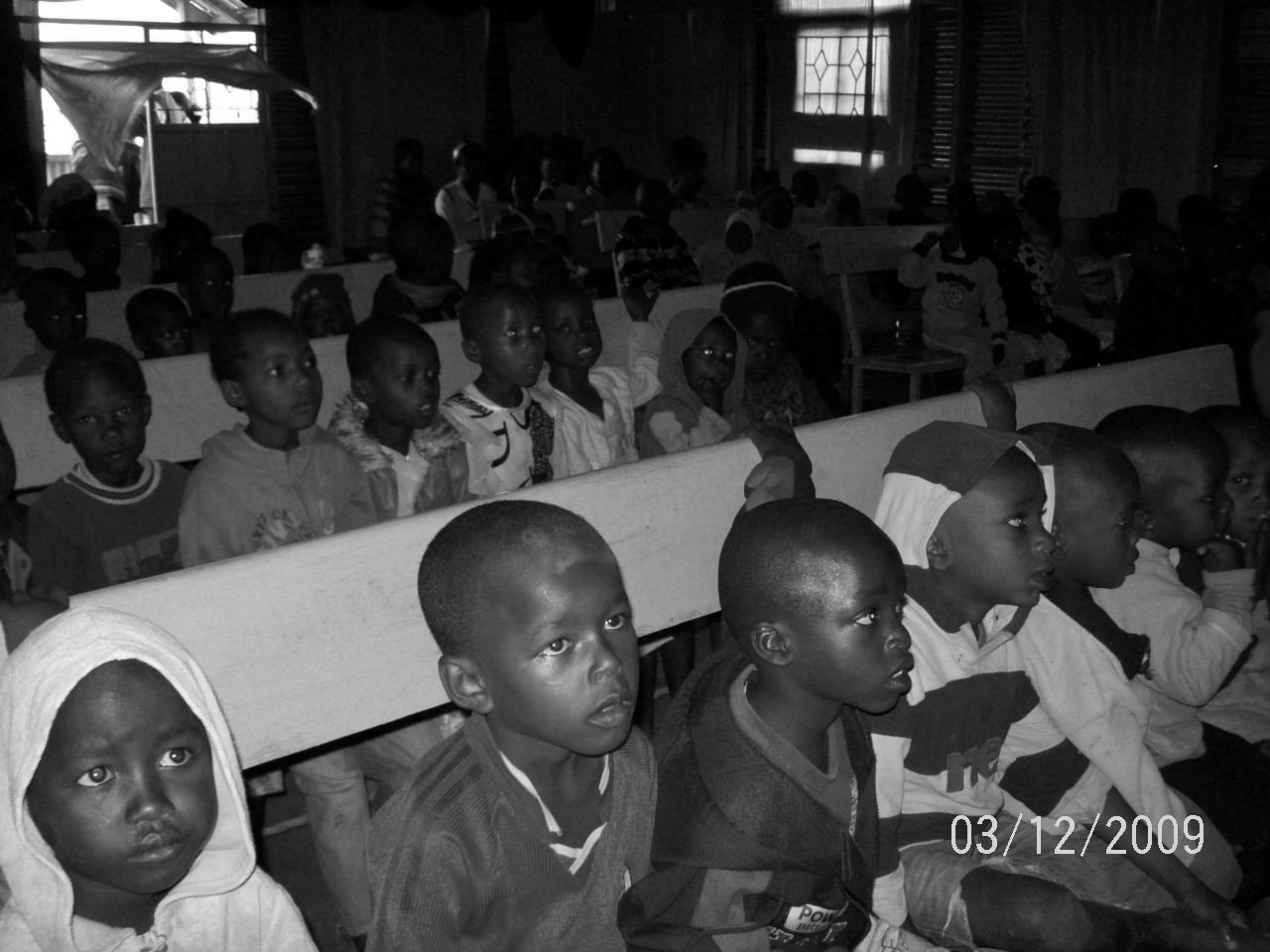
So, after that visit we go home with mixed feelings, and a couple of days later we are in Nakuru, where we visit yet another orphanage, and gather a large group of children in an ironsheet church. I buy them a meal (bread, bananas, juice, candies) and we present them the movie we use to tell them about their rights. It is a success again, and long-term cooperation with that orphanage is in the air. We have a great meal at Pauline's place - Thank you! that gives us all the energy we need tomorrow when we travel to Kisumu to do the real thing - building our own orphanage from the ground.

december 7. Online

I work in a fastfood restaurant and get most things done. After eight hours of typing and clicking the websites are almost up-to-date and email-correspondence has been dealt with. It was nice not to complain about the massively delayed order and the white coffee they mistakenly brought me.


I am excited about next week's surprise.

Merry christmas everyone

From our small village in western kenya we wish you all a merry christmas and a happy new year, more on the orphanage will follow soon. See you in 2010.

december 6. Going to Church.

A lazy sunday morning. Then we go to church together. Four boys walking through the sunny streets of Kayole with bibles under their arms. I feel it would make a good picture, and it also reminds me of the... Beatles.


In the afternoon I decide to work in the cybershop to tell my friends in such far away places like Holland or Germany that I am alright. Electricity had broken down that morning and they had closed the shop. Despite power being back again, we find it still closed and wait for a boy rushing in on a light motorbike to open it for us. I work for five hours straight and still feel like nothing has been done.
In the evening we are invited at the pastor's place for a traditional Kenyan meal which I enjoy very much. I can eat Ugali with my hands now and scoop up the meat with a chunk of the white stuff. I can feel my fatigue though and have a hard time suppressing a yawn. It is great to feel the hospitality of this family and I am really happy to be here. We decide to do the more serious talking with the pastor (about my project) later.

December 2. Joy Valley. Famined orphans.

After a good night's sleep, we start right away, sensitizing in an orphanage called Joy Valley in a slum called Soweto after the South African province. What is the difference between a slum and the house I am living here, at walking distance from Soweto? Slums have semi-permanent buildings made of iron plates, no electricity, no water, no sewerage, in some cases like the infamous Kibera slum "flying toilets". Where I live there is a toilet and one of the neighbours even has a tap so stocking up the water supply means only a 150m walk. And we have a tv so we can follow the news.


We walk to the orphanage, and I see real poverty there. The children have not eaten for two days, the dormitories are not plastered and I see a rat in one of the beds, the common room is not larger than a Western toolshed, they cook on woodfires since they can't afford stoves or paraffine. The director guides me around the orphanage (see
http://charitytravel.blogspot.com/2009/12/joy-valley-orphanage.html)


From my donation they prepare chapati bread, which comes as a big surprise for the children. Of course I want to do something more sustainable than just feeding those kids on one occasion. And I hope that we can achieve just that with our sensitizing program and the publicity I can give them through my project.

When we are done telling the children about their rights, we invite them to watch a movie, which is a great success. 87 Children fit in the small community room, where I build up my pocket projector and start the movie Ice Age 3. The kids love it! A friend translates parts into Swahili and relates the action on the screen to the fundamental values we have told them about. I think we might have created a lasting memory for the kids. We have done so for ourselves, that much is true. Doing this is so rewarding!

December 1. Touchdown in Nairobi.

The plane touches down in Nairobi. It's a new month, and a new continent. Immigration issues are swiftly dealt with; I learn they lowered the price for a visa to 25 dollars to attract more tourists. In the entrance hall the first thing I do is talking to a stranger, and after I made him clear I am not exactly here for tourism he gives me the number of a minister operating a school for the underpriviledged in one of the shantytowns here. I offer the stranger a cup of coffee and call Willys, my contact in this city. He is already on his way to pick me up. On a bumpy busride to the humble dwelling where he is living with his two friends Pony and Geoff, we explain each other about our activities - it turns out our concepts and sentiments are more than compatible and I am looking forward to working together. But today is for sleeping. Willys shows me the bed and I dream away, happy about my more than successful arrival here in Kenya. Tomorrow we'll do our first sensitizing program in an orphanage.


October 10. At the Nigerian embassy.

At the Nigerian Embassy I wait to apply for a visa. Theire is no "blond" on the form for hair color. Applicants are instructed to fill in "black" for the hair and "brown" for the skin. People smile. Their smiles all resemble each other from my perspective. I will make my payment online and talk to the  consul. He tells me he needs more than a week since he is on a trip. They don't even have a person to handle issuing of visas. So I sit there on that leather couch in the highly secured Nigerian embassy and decide to speak my mind. My dear consul, I say, in that case I think my money is better spent in Kenya. They sell visas at the border. You should consider that. As you wish, sir, as you wish. There are more reasons why I say no to Nigeria. I think two months in the Kenya region are definitely not too much. And I need this blow from bureaucracy. It is a well-known fact that bureaucracy will kill me in the end, but until then, I want to stick as many voodoo needles through her skin as I can, to make the imaginary evil body causing all the coldness suffer. And I train to stay very calm, like that too. So as I ask my appliances back and stride out of the consulate, I start to sing

sickening system has done it again
bureaucracy strikes me a blow today
she knows how to hurt in a terrible way
but it will make me stronger
stronger in the end, yes i know i know
it will make me stronger, then
it will make me a better man
to feel how much i hate inhuman bureaucrats
to despise them like contagious sewer rats
to feel it, feel it, and then to conquer it
to be larger than it 
and to smile...

July 31. Seven Trips.


I go out when my couch surfer goes to work and get back home when she is back too. I write in my favorite coffee place, caffeine doesn't make up for flawed inspiration, then I buy myself a cellphone and call my friend Ann. We meet in front of a shopping mall and I am sorry I am too late. I must have lost a lot of weight because she immediately notices my straw appearance. It's no big deal: on our next meeting I will have lost a lot of hair. We hang out in a park and talk about the past year. I learn we've not changed much, from the outset. Change still in the phase of enzymes. Ann surprises me by taking me to a genuine German beer place for dinner. I've seen a "Bierhalle" in Irkutsk, the Russians seem to like it. We share a plate of Bratwurst and three glasses of good draft beer.

June 11. Wasn't there this swine-flu thing?

A scary but improbable continuation of this blog:
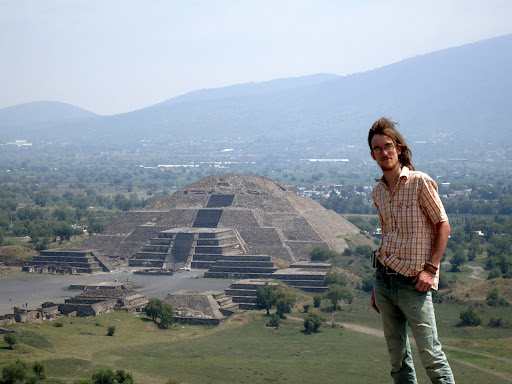
Walking through the ancient Aztec town of Teotihuacan, he feels a light pain in his forehead and a nasty caugh deep down his throat. Yes, he has read the newspaper and he knows that the WHO has just increased the pandemia level to six, and that's as high as they go. He has seen the restaurant and ticket office workers wearing mouth protection, and he remembers the old man with his terrible caugh on the bus two days ago. What if I have swine flu, he thinks. What if, of all the tourists traveling in and out of Mexico, I have the bad luck of catching the flu? So he thinks while walking on the Calle de los Muertos, the four kilometer main axis of the Aztec city. Will they thoroughly examine me, put me in quarantine? Or would this string of the influenza virus make me sick so quickly that I won't make it out of the country alive, hee thinks. How terrible. He must go back to the city, try to find some tamiflu do they have enough? Do they have enough portions for everyone? But the virus will continue doing its destructive work if you only fight the symptoms. He will get sick very soon now and throw up and get all green and magenta and yellow he will suffer terribly for two days and then die anonymously in a quarantined cold hospital bed, surrounded by curious scientists fervently taking notes in their inmaculately white little notebooks.

The real continuation:
The visit to the Aztec ruins is great. Take a bus (33 pesos) from Central del Norte which will bring you right to the entrance of the park in about an hour. The park entrance costs 51 pesos like all other major AAA-rated sites (including Chitzen Itza and Palenque). Ascending the temple of the sun is worth the effort. It's a steep climb but the reward is rich. You look out over the green hills of the region and the temple of the moon. The sun-temple was for Tláloc
the water god, according to recent research. That explains the ten feet moat around it and the child burials (the water deity was seen by the Aztec as the womb of new life as well as the passage chamber to eternal life).
There is an interesting museum about the mural paintings they've excavated here and some smaller temples off the main archeological site that are definitely worth a visit too. I feel like a young Aztec man and imagine how I would have lived. It's my favorite activity around ruins. I do it all the time: you already caught me doing it in the ancient Maya world. Being on the same spot as those great civilizations stimulates my fantasy. The experience of those naked and silent stones, those huge piles of stones, those big timeless soothing stones: that's the reason I'm here.

My friend Kenya shows me some pretty fragments of her city before we crash the couchsurfer's party, that is really nice. My hypothesis that all couchsurfers are friendly gains some strength. I mean, you cannot go like this:
A: All couchsurfers are friendly
B: Socrates is a couchsurfer
C: Thus Socrates is friendly
but you can be pretty sure he would be. I doubt if Socrates would couchsurf, but that's another story.
Related Posts Plugin for WordPress, Blogger...