The morning and me, we have a very short meeting. She decides to leave after half an hour. It's almost noon. Let's have breakfast! And then off to the historical center to walk around and take photographs. That center is not big and quite orderly structured; it's a good idea to explore it on foot. I notice that Parliament, Cathedral and Ruins are very close to each other and imagine they constitute three pillars of Mexico: democracy, religion, and history. It's too hot to dig in that deeper. The Mexicans know what constitutes them better anyway.

Showing posts with label DF. Show all posts.

June 11. Wasn't there this swine-flu thing?
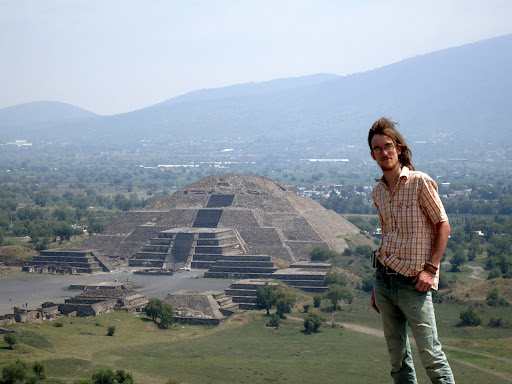 A scary but improbable continuation of this blog:
Walking through the ancient Aztec town of Teotihuacan, he feels a light pain in his forehead and a nasty caugh deep down his throat. Yes, he has read the newspaper and he knows that the WHO has just increased the pandemia level to six, and that's as high as they go. He has seen the restaurant and ticket office workers wearing mouth protection, and he remembers the old man with his terrible caugh on the bus two days ago. What if I have swine flu, he thinks. What if, of all the tourists traveling in and out of Mexico, I have the bad luck of catching the flu? So he thinks while walking on the Calle de los Muertos, the four kilometer main axis of the Aztec city. Will they thoroughly examine me, put me in quarantine? Or would this string of the influenza virus make me sick so quickly that I won't make it out of the country alive, hee thinks. How terrible. He must go back to the city, try to find some tamiflu do they have enough? Do they have enough portions for everyone? But the virus will continue doing its destructive work if you only fight the symptoms. He will get sick very soon now and throw up and get all green and magenta and yellow he will suffer terribly for two days and then die anonymously in a quarantined cold hospital bed, surrounded by curious scientists fervently taking notes in their inmaculately white little notebooks.
The real continuation:
The visit to the Aztec ruins is great. Take a bus (33 pesos) from Central del Norte which will bring you right to the entrance of the park in about an hour. The park entrance costs 51 pesos like all other major AAA-rated sites (including Chitzen Itza and Palenque). Ascending the temple of the sun is worth the effort. It's a steep climb but the reward is rich. You look out over the green hills of the region and the temple of the moon. The sun-temple was f
 or Tláloc
the water god, according to recent research. That explains the ten feet moat around it and the child burials (the water deity was seen by the Aztec as the womb of new life as well as the passage chamber to eternal life).
There is an interesting museum about the mural paintings they've excavated here and some smaller temples off the main archeological site that are definitely worth a visit too. I feel like a young Aztec man and imagine how I would have lived. It's my favorite activity around ruins. I do it all the time: you already caught me doing it in the ancient Maya world. Being on the same spot as those great civilizations stimulates my fantasy. The experience of those naked and silent stones, those huge piles of stones, those big timeless soothing stones: that's the reason I'm here.
My friend Kenya shows me some pretty fragments of her city before we crash the couchsurfer's party, that is really nice. My hypothesis that all couchsurfers are friendly gains some strength. I mean, you cannot go like this:
A: All couchsurfers are friendly
B: Socrates is a couchsurfer
C: Thus Socrates is friendly
but you can be pretty sure he would be. I doubt if Socrates would couchsurf, but that's another story.
June 10. This is a big city.
 The bus penetrates Mexico city profoundly. I can walk up to the central square (Zocalo) where the cathedral and the government palace are facing each other. I'll do that tomorrow. First let me arrive in this city, so tenderly called "Deye Effe" by its twenty-one million inhabitants. The bus is parking, I get out, strap my backpack on and start walking. Walk, walk. Through a neighborhood that was supposed to be dangerous, but looked very safe to me. Don't gimme dangerous I've been in [Guatemala city]. You can use this yourself, just substitute the name of any badly reputed city like Freetown, Baghdad, Nairobi, or a dangerous city like New York. Anyway, I arrive at that central area and find the subway entrance. I'm couchsurfing again and it will be good.
It means that I am part of this city from day one. It means that I'll go out with a group of Mexicans and adventurous European exchange students, stand on the roof of their appartment building chatting in Spanish, big bottles of beer in our hands and a very cute dog to cuddle. It means we'll all go out walking the streets of D.F. in search for a nice bar which we only find dangerously near closing time (they close ridiculously early here, like 2am) and it means that we all retreat to the same appartment where I crash on a comfortable red heart-shaped bed - alone. Welcome to Mexico City.
June 9. Myriad Intentionality.
The Theory of myriad intentionality. I wrote about this earlier; here I want to be a little bit more precise. But only a little bit. This is not supposed to be a philosophical tractatus and I am not supposed to be a genius to write one. So, then, what is the definition of intentionality? It is definitely some thought: we don't ascribe it to other animals precisely because we assume they don't think. Intentionality means we are headed somewhere: it is a thought about the future. But not just any thought about the future will do. We can have phantasies about future civilizations, the end of the world, international sport events in which we don't participate without having an intention. What we need of course, is active participation in a future event. So, when we think about some event in the future, sa y walking the beautiful neighbor's dog, in a way that we imagine our active participation in it, does this always mean we have the intention to, in this case, walk the dog? What if we were just dreaming about doing it? So a final criteria seems to be needed: the belief that our participation in the future event is real. Thus we arrive at:
I. A thought about a future event with active participation and the belief that this is real.
...and of course raised some new questions, as real philosophers should. First of all, what is an event? Any occurence, any movement of atoms so you might? No. The belief that a future event is real implies that it must be something like what we preconceive as an event. And this set of occurences is easily defined: anything that can happen can be described with action verbs. When, and only when, we can formulate an action-verbial expression for it, we are talking about an event. Other occurences cannot be events. Still, that definition seems to be too wide: we describe hot lava streams and water falls, the movement of butterflies and elephants with action verbs, but we can never actively participate in it. Still, I make the case that they are events. Here is why. In case of a delirium, we could believe for example that we can pull like gravity itself. We can develop the intention to pull other objects within our "atmosphere". Those intentions perfectly comply with (I). So intentions can be directed towards physically impossible events. Also, intentions need not to be exact. Without a where, when, how, and why it is still possible to have the intention to kill the president. The only requirement is a "that".
II. An event is any occurence that we can describe in terms of action verbs.
...now the notion of belief still has to be clarified. We believe that something is going to happen, for example that we will have lunch in one hour. I have no time to dig much deeper here, so let's resort to ontology. When we belief that an event is going to happen we treat it like a different ontological category than its alternatives.
III. A belief that a certain event E is going to happen exists when and only when we treat it like a different ontological category than all its alternatives.
These are the preliminaries. I'm sure they can be questioned and I encourage you to do that. Once we have a notion of intentionality, we have to ask how we organize more than one intentionality, since our goal here is to establish a distinction between 'normal' intentional behavior and 'myriad' intentional behavior. Now it's straightforward to say that we organize intentions chronologically and causally. We tie them together to chains as you might. A simple daily task like
1. go out
2. take a bus
3. buy groceries
4. cook
5. still appetite
is governed by intentions derived from (5) alone. Is there another way? Yes, of course. We could dream, try to follow multiple 'chains' at once, intertwine them. There has to be a relation, but one that prevents all intentions to be deducted from one überintention. Total randomness doesn't work here because that would result in a multiple personality. What we are after is a single personality with a wider intentional structure.
1. go out
2. enjoy the weather
3. buy groceries
Here the events not all causally connected and hence cannot be derived from (3). Still, they are intentions a single person can combine in his thoughts by means of a more abstract overall intention: that of bodily joy. Now the myriad intentionality knows about this and tries to avoid it - yes, that is its dogma. So the myriad intentionalist tries to avoid the possibility of that abstract overall intention. He is not able to do that: that's his tragic nature, but he is able to postpone it, to stretch the web of intentions as much as possible as it were.
1. go out
2. give to a beggar
3. eat a delicious lunch
4. do a self-invented dance in the park
5. buy groceries
6. feed half of it to the ducks
This 'chain' of events is harder to organize in advance. Yet this is what the myriad intentionalist tries to do. Here's his paradox: in order to broaden the horizon of our intentional behavior he invents a bunch of intentions and then ties them together as tight as possible. This ability to structure them in advance can be trained. The myriad intentionalist invents logical connections between his actions in order to prevent his mind from subsuming them under one abstract imperative. For example:
1. go out
i1. follows from 7 --> imagination of other people's hunger
2. give money to a beggar
i2. follows from i1 --> reminder of your own hunger
3. eat a delicious lunch
i3. follows from i2 --> the discrepancy i1-i2 spark a crazy act
4. do a self-invented dance in the park
i4. follows from i3 --> discharge leads back to normality
5. buy groceries
i5. follows from i4 --> the discrepancy i3-i4 spark another crazy act
6. feed half of it to the ducks
i6. follows from i5 --> discharge leads back to original intention
7. go home and still appetite
Exercise. Think of random actions (like I want to go to Cuba, I want to scuba dive, I want to climb the Everest, I want to marry in Indonesia). Do free association to find out which series you produce and what relationing principles you use.
I spend the day walking around in the beautiful town of San Christobal, taking pictures, having a good cup of coffee at the beautiful central square. Yesterday night, due to all my nonsense, I almost got lost. I just failed to find the door of my hostel and kept walking for about an hour, examining all the streets in the vicinity of the central square. I asked a few people and reconstructed my earlier walk. Nobody seemed to know about that hostel. Was it dissolved in time or something? I couldn't believe that. When I insisted, they said "wait a minute, the people next door do lodging". It turned out to be my hostel! The hosteling sign was taken off the street, and the heavy door tightly locked - nothing reminded of a hostel. I knocked the door and it was opened (very biblical) by the lady I'd seen that afternoon. The anxiety about the disguised hostel entrance escaped my lips only as a dim comment that didn't pass the counter, I forgave (very biblical) and I went to bed.
At night, in the bus to Mexico City, I speak to a kind lady and dream about myriad intentionality (very unbiblical).
y walking the beautiful neighbor's dog, in a way that we imagine our active participation in it, does this always mean we have the intention to, in this case, walk the dog? What if we were just dreaming about doing it? So a final criteria seems to be needed: the belief that our participation in the future event is real. Thus we arrive at:I. A thought about a future event with active participation and the belief that this is real.
...and of course raised some new questions, as real philosophers should. First of all, what is an event? Any occurence, any movement of atoms so you might? No. The belief that a future event is real implies that it must be something like what we preconceive as an event. And this set of occurences is easily defined: anything that can happen can be described with action verbs. When, and only when, we can formulate an action-verbial expression for it, we are talking about an event. Other occurences cannot be events. Still, that definition seems to be too wide: we describe hot lava streams and water falls, the movement of butterflies and elephants with action verbs, but we can never actively participate in it. Still, I make the case that they are events. Here is why. In case of a delirium, we could believe for example that we can pull like gravity itself. We can develop the intention to pull other objects within our "atmosphere". Those intentions perfectly comply with (I). So intentions can be directed towards physically impossible events. Also, intentions need not to be exact. Without a where, when, how, and why it is still possible to have the intention to kill the president. The only requirement is a "that".
II. An event is any occurence that we can describe in terms of action verbs.
...now the notion of belief still has to be clarified. We believe that something is going to happen, for example that we will have lunch in one hour. I have no time to dig much deeper here, so let's resort to ontology. When we belief that an event is going to happen we treat it like a different ontological category than its alternatives.
III. A belief that a certain event E is going to happen exists when and only when we treat it like a different ontological category than all its alternatives.
These are the preliminaries. I'm sure they can be questioned and I encourage you to do that. Once we have a notion of intentionality, we have to ask how we organize more than one intentionality, since our goal here is to establish a distinction between 'normal' intentional behavior and 'myriad' intentional behavior. Now it's straightforward to say that we organize intentions chronologically and causally. We tie them together to chains as you might. A simple daily task like
1. go out
2. take a bus
3. buy groceries
4. cook
5. still appetite
is governed by intentions derived from (5) alone. Is there another way? Yes, of course. We could dream, try to follow multiple 'chains' at once, intertwine them. There has to be a relation, but one that prevents all intentions to be deducted from one überintention. Total randomness doesn't work here because that would result in a multiple personality. What we are after is a single personality with a wider intentional structure.
1. go out
2. enjoy the weather
3. buy groceries
Here the events not all causally connected and hence cannot be derived from (3). Still, they are intentions a single person can combine in his thoughts by means of a more abstract overall intention: that of bodily joy. Now the myriad intentionality knows about this and tries to avoid it - yes, that is its dogma. So the myriad intentionalist tries to avoid the possibility of that abstract overall intention. He is not able to do that: that's his tragic nature, but he is able to postpone it, to stretch the web of intentions as much as possible as it were.
1. go out
2. give to a beggar
3. eat a delicious lunch
4. do a self-invented dance in the park
5. buy groceries
6. feed half of it to the ducks
This 'chain' of events is harder to organize in advance. Yet this is what the myriad intentionalist tries to do. Here's his paradox: in order to broaden the horizon of our intentional behavior he invents a bunch of intentions and then ties them together as tight as possible. This ability to structure them in advance can be trained. The myriad intentionalist invents logical connections between his actions in order to prevent his mind from subsuming them under one abstract imperative. For example:
1. go out
i1. follows from 7 --> imagination of other people's hunger
2. give money to a beggar
i2. follows from i1 --> reminder of your own hunger
3. eat a delicious lunch
i3. follows from i2 --> the discrepancy i1-i2 spark a crazy act
4. do a self-invented dance in the park
i4. follows from i3 --> discharge leads back to normality
5. buy groceries
i5. follows from i4 --> the discrepancy i3-i4 spark another crazy act
6. feed half of it to the ducks
i6. follows from i5 --> discharge leads back to original intention
7. go home and still appetite
Exercise. Think of random actions (like I want to go to Cuba, I want to scuba dive, I want to climb the Everest, I want to marry in Indonesia). Do free association to find out which series you produce and what relationing principles you use.
I spend the day walking around in the beautiful town of San Christobal, taking pictures, having a good cup of coffee at the beautiful central square. Yesterday night, due to all my nonsense, I almost got lost. I just failed to find the door of my hostel and kept walking for about an hour, examining all the streets in the vicinity of the central square. I asked a few people and reconstructed my earlier walk. Nobody seemed to know about that hostel. Was it dissolved in time or something? I couldn't believe that. When I insisted, they said "wait a minute, the people next door do lodging". It turned out to be my hostel! The hosteling sign was taken off the street, and the heavy door tightly locked - nothing reminded of a hostel. I knocked the door and it was opened (very biblical) by the lady I'd seen that afternoon. The anxiety about the disguised hostel entrance escaped my lips only as a dim comment that didn't pass the counter, I forgave (very biblical) and I went to bed.
At night, in the bus to Mexico City, I speak to a kind lady and dream about myriad intentionality (very unbiblical).
Subscribe to:
Posts (Atom)
